
Reviewed and published by Surakat Ahmed, Founder & Managing Director, WeCare24 Home Nursing & Security Solutions (ISO 9001:2015 certified). More about WeCare24. Published: 28 August 2026 · Last updated: 29 August 2026
This article is for informational purposes only and does not constitute medical or professional care advice. Consult a qualified healthcare professional or licensed home care agency before making any care decisions.
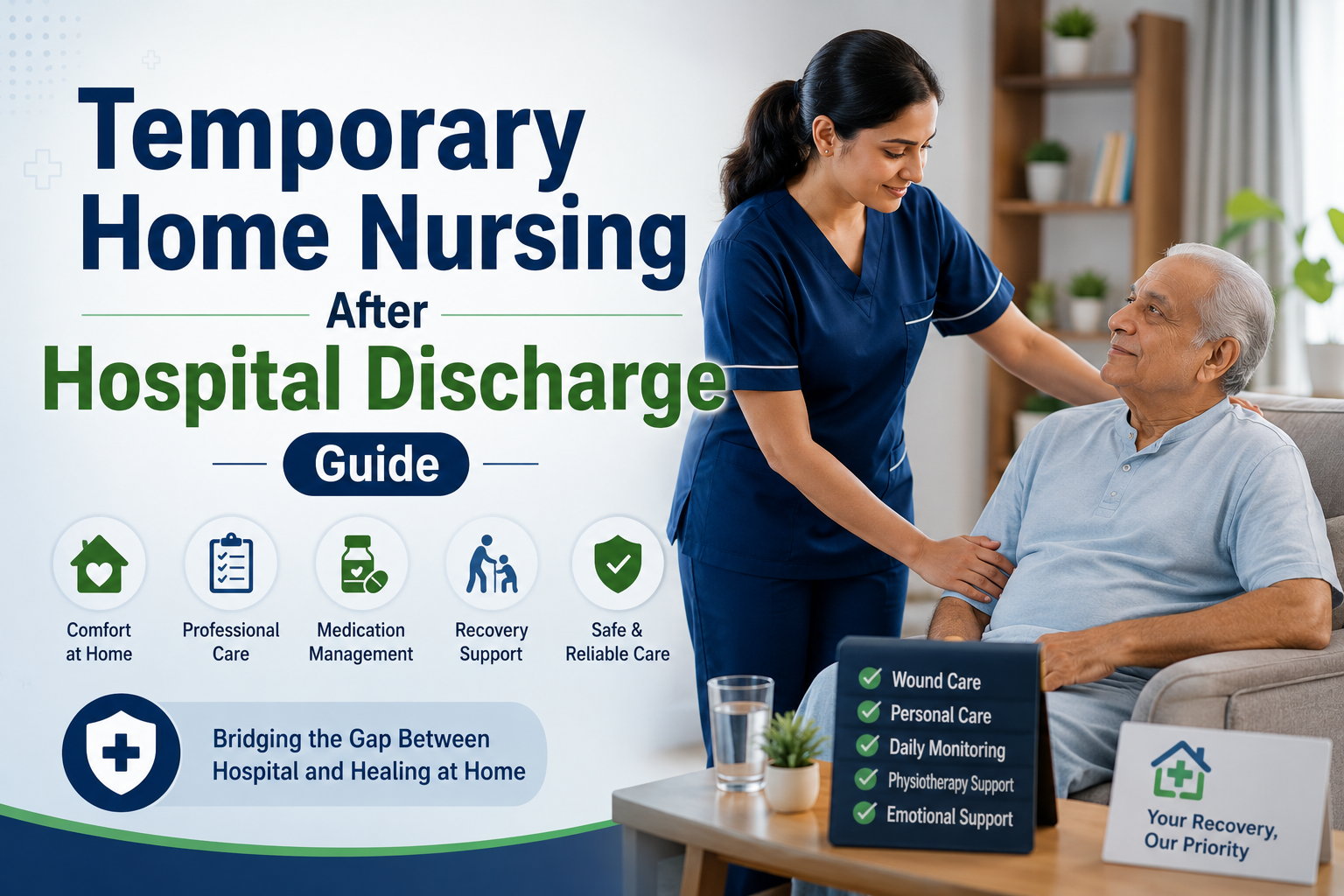
Leaving the hospital doesn’t always mean the recovery is over. A discharge summary means a patient is stable enough to continue healing outside a hospital bed, not that every part of that recovery can be managed without help. For some patients, the days or weeks right after discharge are exactly when nursing care after hospital discharge matters most, before a wound has fully closed, before mobility has returned, before a new medication routine has become second nature. Temporary home nursing exists for this specific window: short-term, professional support at home while a patient transitions back to normal activity, rather than an ongoing arrangement. Good post-discharge nursing care depends entirely on the patient’s condition and what the treating doctor has advised, not on a fixed rule that applies to everyone.
What Is Temporary Home Nursing After Hospital Discharge?
Temporary or short-term home nursing, sometimes described as post-hospitalization home care, is professional nursing support provided at home for a limited, defined period, typically while a patient recovers from a specific event: a surgery, an illness, or a hospital stay. It differs from long-term home care mainly in duration and purpose. Long-term care usually supports an ongoing condition with no fixed end date, while temporary nursing is built around a recovery window with a natural conclusion, once the patient regains enough independence to manage without professional support, or until the treating doctor advises otherwise. Some patients need this kind of support because a hospital’s structured routine, medication timing, wound checks, mobility supervision, doesn’t disappear just because the patient has gone home; it has to continue somewhere, and for a period it may need a trained person managing it rather than family members learning as they go.
Why Do Patients Need Nursing Support After Hospital Discharge?
A handful of situations come up repeatedly in the days after discharge:
- Recovery after surgery, when wound healing and mobility both need supervision
- Reduced mobility that makes basic movement around the home difficult or risky
- General weakness after a prolonged hospital stay
- A new medication or treatment routine that needs to be followed exactly
- Wound or dressing care that needs to happen on schedule and correctly
- Assistance with personal care while the patient is still regaining strength
- Monitoring of basic health parameters the discharge team asked to be tracked
- Recovery from an illness or medical procedure more broadly
When Is Temporary Home Nursing Recommended?
A few specific situations tend to make professional support worth considering.
After Surgery or a Medical Procedure
Home nursing after surgery typically covers recovery support, wound-related care as prescribed, mobility assistance, and following the specific post-discharge instructions the surgical team provided.
For Patients With Limited Mobility
Assistance with movement, regular position changes, personal-care support, and reducing the avoidable risks, pressure sores, falls, that come with prolonged immobility.
When Family Members Cannot Provide Full-Time Care
Work commitments, elderly family members who themselves need additional assistance, or simply needing trained support during specific hours of the day rather than around the clock.
When the Patient Requires Regular Nursing Tasks
Dressing changes where professionally indicated, medication-related assistance within the nurse’s scope, monitoring and recording relevant health parameters, and following the care plan the healthcare team provided at discharge.
Who May Benefit From Short-Term Home Nursing?
Several patient groups commonly use temporary home nursing, though not every patient in these groups will need it; the deciding factor is always the individual’s actual condition and care plan, not the category they fall into:
- Post-surgery patients
- Elderly patients recovering at home
- Patients recovering from a serious illness
- Patients with temporary mobility limitations
- Patients requiring wound-related care
- Patients transitioning from hospital care back to independent living
What Does a Temporary Home Nurse Do?
The exact responsibilities depend entirely on the patient’s prescribed care plan, but generally include:
- Assistance with personal care
- Mobility and positioning support
- Monitoring basic health parameters when required
- Wound or dressing care, when within the nurse’s qualifications and the care plan
- Medication assistance according to professional instructions
- Maintaining basic care records
- Communicating relevant changes to family members or the appropriate healthcare professional
- Supporting the patient’s broader recovery routine
How Long Is Temporary Home Nursing Usually Needed?
There’s no fixed duration that applies to every patient. Some recover enough to manage independently within a few days; others need several weeks of support. What determines the actual length includes the type of illness or procedure, the patient’s current mobility level, how dependent they are on assistance for daily tasks, which nursing tasks are actually required, and, most importantly, the doctor’s or healthcare team’s recommendation. Treating the initial estimate as a starting point rather than a fixed number, and adjusting based on how recovery is actually going, tends to work better than committing to a rigid timeline upfront.
Temporary Home Nursing vs Family Caregiving
| Temporary Home Nursing | Family Caregiving | |
| Provided by | Trained nursing professionals | Family members |
| Scope | Can support specific nursing-related tasks | Mainly personal and emotional support |
| Care plan | Can follow a professional care plan directly | Follows instructions given by healthcare professionals |
| Best suited for | Situations needing specialised support | Companionship and everyday assistance |
These two aren’t competing options. Many families find the two work best together, professional nursing covering the tasks that need training, family covering the presence and support that only they can provide, rather than choosing one instead of the other.
How to Prepare Your Home Before the Patient Arrives
- Keep the patient’s room clean and easily accessible
- Arrange a comfortable bed and any necessary mobility support
- Keep medicines and medical documents organised in one place
- Ensure easy, safe access to the bathroom
- Remove unnecessary obstacles from walking areas
- Keep emergency contact information visible and available
- Follow the specific discharge instructions provided by the hospital
What Information Should Families Share With the Home Nurse?
Handing over complete information at the start avoids gaps later. Useful documents and details include:
- Hospital discharge summary
- Current medication list
- Doctor’s instructions
- Documented allergies, if any
- Recent procedure or surgery details
- Wound-care instructions
- Mobility limitations
- Dietary instructions
- Important emergency contacts
- Follow-up appointment details
How to Choose Temporary Home Nursing Support
- Nurse qualifications and experience
- Experience relevant specifically to the patient’s condition
- Availability and shift duration that matches actual need
- How the provider communicates with family members
- Replacement or backup arrangements if the assigned nurse is unavailable
- Whether care is properly documented
- Transparency about services included and charges
- Ability to follow the patient’s prescribed care plan exactly
When Should Families Contact a Doctor After Discharge?
Families should follow the hospital’s discharge instructions closely and seek medical advice promptly if they notice anything new, worsening, or concerning, rather than waiting to see if it resolves on its own. Situations that warrant contacting a doctor or seeking medical attention include:
- Sudden difficulty breathing
- Severe or worsening pain
- Unusual bleeding
- Sudden confusion or a significant change in responsiveness
- High or persistent fever
- Any significant deterioration in the patient’s condition
A home nurse supports recovery within the scope of the prescribed care plan, but is not a substitute for emergency medical care. If something looks urgent, contacting a doctor or emergency services directly takes priority over anything else.
Temporary Home Nursing in Bangalore
For patients recovering at home in Bangalore, temporary nursing support can be a useful bridge between hospital discharge and full independence, particularly in the first days after a surgery or serious illness. The right type and duration of support should be based on the patient’s specific condition and care plan rather than a standard package, and it’s worth assessing actual requirements, wound care, mobility needs, medication routines, before comparing providers. Families exploring options in the city can look into WeCare’s home nursing support in Bangalore as one starting point for that comparison.
Frequently Asked Questions
How is temporary home nursing different from hiring a full-time caregiver?
Temporary home nursing is provided by trained nursing professionals for a defined recovery period and can carry out nursing-related tasks within their scope, such as wound care or medication assistance. A caregiver’s role is generally non-clinical, personal care and daily support, and doesn’t involve the same level of professional care from the training a nurse holds.
Can temporary home nursing be extended if recovery takes longer than expected?
Yes, generally. Since duration is based on the patient’s actual recovery rather than a fixed schedule, support can usually be extended if the treating doctor or healthcare team recommends continuing it, and can also end sooner if recovery goes well.
Does temporary home nursing include medical equipment like oxygen or IV support?
This depends on the patient’s specific care plan and what the provider offers. Any equipment-related care should be discussed and confirmed upfront, based on what the discharge instructions and treating doctor have specified, rather than assumed to be automatically included.
Who decides whether a patient needs a nurse or can manage with family support alone?
This should be based on the patient’s actual condition, the complexity of the required care, and the treating doctor’s guidance, not on assumptions about what family members can manage. When nursing-related tasks like wound care or medication administration are involved, professional input is worth getting before deciding.
Is temporary home nursing available for just a few hours a day, or only full shifts?
Shift options vary by provider and by what the patient’s care plan actually requires; some families need a few hours of daily support, while others need extended or round-the-clock coverage during the early recovery period. It’s worth discussing the specific requirement directly with a provider rather than assuming only one format is available.
About the Author
L K Monu Borkala is a digital marketing strategist with 20+ years of experience producing informational content across healthcare services, home care, and professional services verticals. This article is produced for informational purposes only. Consult a licensed healthcare provider or registered home care agency before making decisions about home nursing or care arrangements. LinkedIn: linkedin.com/in/monuborkala
Planning a Recovery at Home After Discharge?
If a hospital discharge is coming up and you’re weighing whether professional support is needed for the recovery period, sharing the discharge summary and care requirements is the fastest way to get a clear recommendation rather than guessing at what’s needed.
Talk to WeCare About Short-Term Nursing Support – Call Now | WhatsApp Us | Request a Care Assessment
Note: All fees mentioned are approximate and subject to change. Please contact us for the latest pricing as of September 2026.
