
Published: · Last updated:
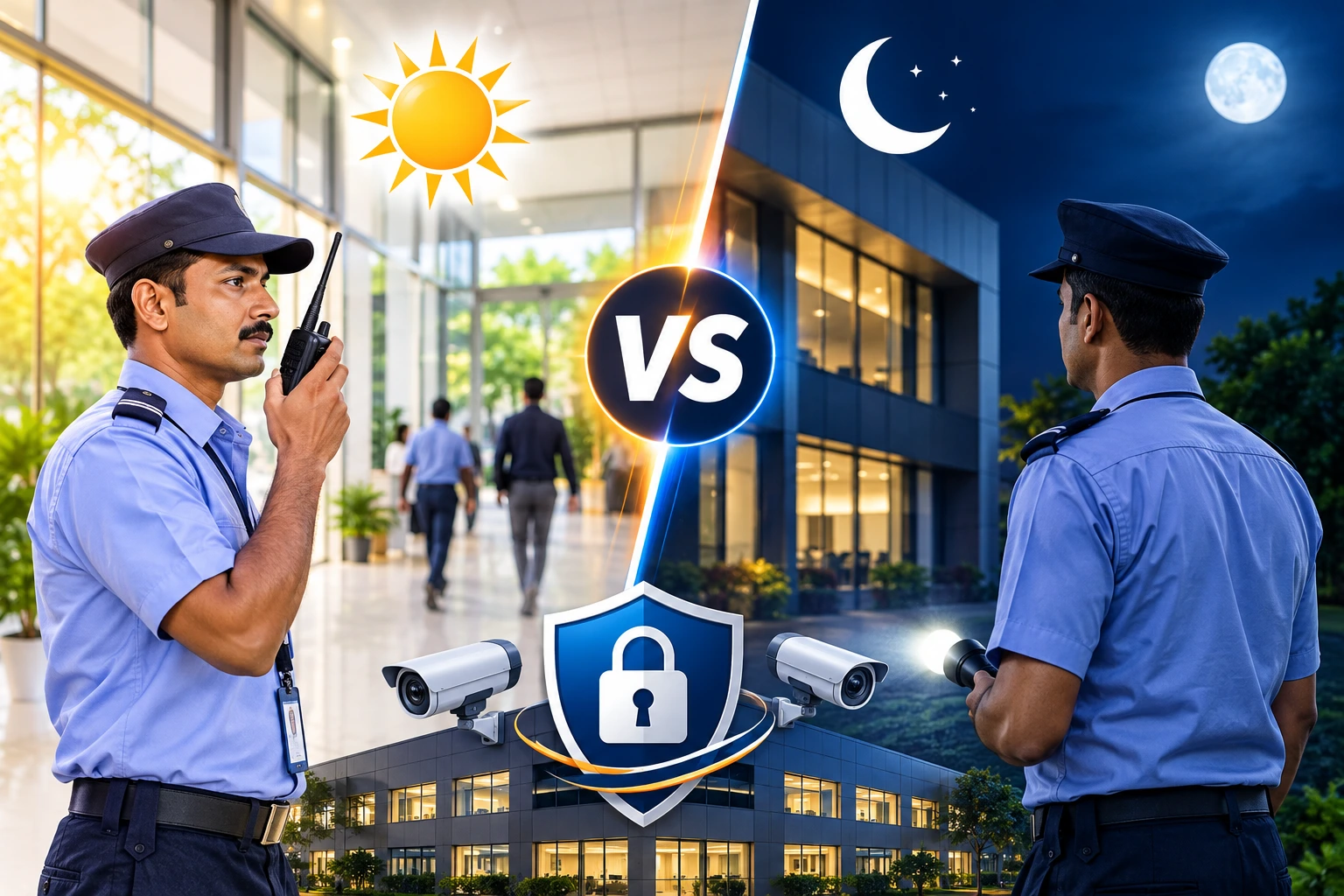
Day shift vs night shift security serves different purposes in a corporate office. Day shift guards manage employee and visitor access, monitor entry points and handle parking. Night shift guards protect the premises through patrols, CCTV monitoring and intrusion response. Most offices need day coverage at minimum; offices with equipment, server rooms or multiple shifts need both.
A corporate office at 10 AM and the same office at 10 PM face different security risks. During the day, the challenge is managing the flow of employees, visitors, delivery personnel and contractors through access points. At night, the challenge shifts to protecting an empty or near-empty building from intrusion, theft and property damage.
The security guard duties, training and staffing for each shift are different. This guide compares day shift security guards and night shift security guards, explains the risks specific to each period and helps facility managers decide the right coverage for their corporate office security needs.
Why Corporate Offices Need Security During Day and Night
Corporate security services requirements extend beyond the hours employees are present. During the day, guards manage access control and workplace safety. After hours, guards protect assets that remain on the premises: computers, servers, documents, inventory and office furniture.
Common reasons corporate offices need security across both shifts:
- Preventing unauthorized access during and after business hours
- Protecting employees from workplace safety incidents
- Safeguarding equipment, data storage and confidential documents
- Managing visitor and delivery movement during business hours
- Responding to fire alarms, medical emergencies or security breaches
- Maintaining an audit trail of all entry and exit activity
- Meeting insurance and compliance requirements that mandate on-site security presence
In Mangalore, Bangalore and Mysore, commercial offices in IT parks, standalone buildings and mixed-use complexes each have different security profiles. An IT park may share perimeter security with other tenants but need dedicated lobby guards. A standalone office building needs both access control and perimeter patrols.
What Do Day Shift Security Guards Do?
Day shift security guards are the first point of contact for everyone entering the office. Their responsibilities focus on people management and access control:
Access management: Verifying employee ID cards, registering visitors with photo ID, issuing visitor badges and maintaining a digital or physical visitor log. In multi-tenant buildings, day guards also verify which company and floor each visitor is authorised to access.
Reception and lobby monitoring: Maintaining a visible presence at the reception or lobby entrance. Directing visitors to the correct floor or meeting room. Handling deliveries and courier parcels.
Vehicle and parking management: Controlling vehicle entry at boom barriers or gates. Recording vehicle numbers. Managing parking allocation, especially during peak morning hours.
Emergency support: Assisting with fire drills and evacuation procedures. Providing first-response support during medical emergencies until paramedics arrive. Knowing the location of fire extinguishers, first-aid kits and emergency exits.
What Do Night Shift Security Guards Do?
Night shift security guards work in a quieter environment with fewer people but higher risk per incident. Their responsibilities focus on surveillance and protection:
Perimeter patrols: Walking scheduled rounds of the building exterior, parking areas, stairwells and common corridors. Checking that all external doors and windows are locked. Verifying that fire exits are accessible and unobstructed.
CCTV monitoring: Watching live camera feeds for unusual movement in and around the premises. Identifying loitering, attempted entry or suspicious vehicles. Flagging camera malfunctions or blind spots.
Access control: Verifying credentials of any person entering after hours: late-working employees, cleaning staff, maintenance teams. Maintaining a log of all after-hours entry and exit.
Incident response: Responding to intruder alarms, fire alarms or unusual sounds. Contacting local police or the building management in case of an emergency. Documenting every incident in the security log with time, location, description and action taken. Night guards are often the only people on the premises when an incident occurs, which makes training and clear escalation procedures critical.
Day Shift vs Night Shift Security: Key Differences
The core difference is what each shift protects against. Day shift manages people; night shift protects property. Here is a side-by-side comparison:
| Security Factor | Day Shift | Night Shift |
| Primary focus | Employee and visitor management | Premises and asset protection |
| Entry monitoring | High traffic: employees, visitors, deliveries | Restricted: authorised personnel only |
| Patrols | Common areas, lobbies, parking during business hours | Full premises including exterior, stairwells, restricted areas |
| CCTV role | Monitoring access points and visitor areas | Continuous surveillance of all cameras |
| Parking security | Managing vehicle entry, exit and allocation | Monitoring parked vehicles and perimeter |
| Top risks | Unauthorised visitors, tailgating, ID fraud | Break-ins, theft, trespassing, vandalism |
| Staffing | Higher headcount (more access points active) | Fewer guards but longer patrol routes |
| Communication | Regular interaction with employees and visitors | Primarily internal (control room, management) |
Common Security Risks and How to Choose Your Coverage
Daytime risks: Unauthorised visitors entering office areas by tailgating through access-controlled doors. Theft of personal belongings (laptops, phones, bags) from desks or meeting rooms during open hours. Delivery personnel or contractors accessing restricted areas. Vehicle-related incidents in parking areas.
Nighttime risks: Break-in attempts through windows, service doors or poorly secured access points. Theft of computers, monitors, projectors and other portable equipment. Trespassing around the building perimeter. Delayed emergency response because of an empty building. Electrical or fire hazards going undetected.
To decide between day-only, night-only or both-shift coverage, evaluate these factors:
- Operating hours: single shift (9 to 6) offices may need day coverage only; offices with evening or night shifts need coverage during those hours
- Asset value: offices with server rooms, expensive equipment or sensitive documents need night coverage regardless of operating hours
- Building type: standalone offices need perimeter security at night; offices in managed commercial buildings may share night security with other tenants
- Location: offices in isolated commercial zones or areas with higher crime rates need night guards
- Regulatory requirements: some industries (banking, data centres, healthcare) have mandated security coverage standards
When Your Corporate Office Needs 24-Hour Security
Round-the-clock workplace security measures are necessary for:
- IT companies and BPO centres with employees working in multiple shifts
- Offices in commercial buildings that operate beyond standard business hours
- Facilities with server rooms, data centres or restricted laboratory areas
- Buildings storing high-value inventory, equipment or confidential records
- Offices in locations with limited police patrol coverage at night
For 24-hour coverage, security agencies deploy guards in rotating 8-hour or 12-hour shifts with documented handover procedures. Each shift handover includes a written log of incidents, visitor records and pending tasks. PSARA-licensed agencies in Karnataka follow state regulations on private security deployment that cover guard training, working hours and welfare requirements.
Professional security planning accounts for shift fatigue, guard rotation and adequate rest periods. Understaffed night shifts are a common cause of security lapses. Agencies like WeCare Security assess the premises, recommend staffing levels and manage shift scheduling so that coverage remains consistent.
How to Manage Security Shift Handovers Effectively
The transition between day and night shifts is when security gaps are most likely. A guard leaving and a guard arriving at the same time creates a window where no one is fully in charge. Proper handover procedures close this gap.
Written handover log: The outgoing guard hands over a written or digital log covering all incidents, visitor records, maintenance issues and pending tasks from the shift. The incoming guard reads and signs the log before the outgoing guard leaves.
Physical walkthrough: The incoming guard walks the premises with the outgoing guard. They check locked doors, CCTV camera status, fire equipment and any areas flagged during the shift. This takes 10 to 15 minutes and prevents the ‘I assumed it was fine’ problem.
Key and access handover: Keys to restricted areas, control room access codes and two-way radios transfer directly from guard to guard. No keys should be left unattended between shifts.
Security agencies that follow structured handover protocols, as recommended by the Bureau of Indian Standards security guidelines (rel=”nofollow”), reduce incident response gaps and maintain continuous accountability.
Conclusion
Day shift vs night shift security is not a matter of choosing one over the other. Each shift addresses different risks, and office security guard duties differ accordingly. Day guards manage people; night guards protect property. The right corporate office security plan matches guard deployment to your operating hours, the value of assets on the premises and the building’s risk profile.
Evaluate your office’s specific needs, compare the daytime and nighttime risks outlined above and consult a PSARA-licensed security provider for a staffing recommendation. For offices in Mangalore, Bangalore and Mysore, professional security guard services from a trained team ensure consistent coverage across both shifts.
Need Reliable Security Coverage for Your Corporate Office?
Every corporate office has different security requirements during daytime and nighttime operations. Get professional support to plan suitable security coverage for your premises, employees and business assets.
Enquire: Contact WeCare Security | Phone: +91 63643 03333
Frequently Asked Questions
What is the difference between day shift and night shift security duties?
Day shift security focuses on managing employee and visitor access, verifying identities, monitoring reception areas and handling parking. Night shift security focuses on premises protection, perimeter patrols, CCTV monitoring, checking locked areas and responding to alarms or intrusion attempts. Day shifts handle higher foot traffic; night shifts handle higher surveillance responsibility.
Does a corporate office need security guards at night if no employees are working?
Yes. Empty offices are vulnerable to break-ins, equipment theft and property damage. Night security guards conduct patrols, monitor CCTV, check access points and respond to emergencies. Offices with servers, expensive equipment or confidential documents need night coverage even when no employees are present.
How many security guards does a corporate office need per shift?
The number depends on office size, number of access points, floors and parking areas. A small office with one entrance may need one guard per shift. A multi-floor building with basement parking, multiple entry points and a lobby may need three to five guards per shift. A PSARA-licensed security provider can assess your premises and recommend staffing.
What qualifications should corporate security guards have?
Security guards should be trained by a PSARA-licensed agency. Look for guards with training in access control, CCTV operation, fire safety, emergency evacuation and incident reporting. For corporate offices, communication skills and professional conduct are important since guards interact with employees, clients and visitors daily.
Is 24-hour security necessary for all corporate offices?
Not all offices need 24-hour coverage. Offices that operate in a single daytime shift with no valuable equipment stored overnight may need only day security. Offices with multiple shifts, server rooms, expensive equipment, restricted areas or high-value inventory should consider round-the-clock coverage. Evaluate your operating hours, assets and neighbourhood risk before deciding.
About the Author
Surakat Ahmed is the Founder and CEO of WeCare Home Nursing and Security, a PSARA-licensed security and home care provider serving Mangalore, Bangalore, Udupi and Mysore since 2019.
