
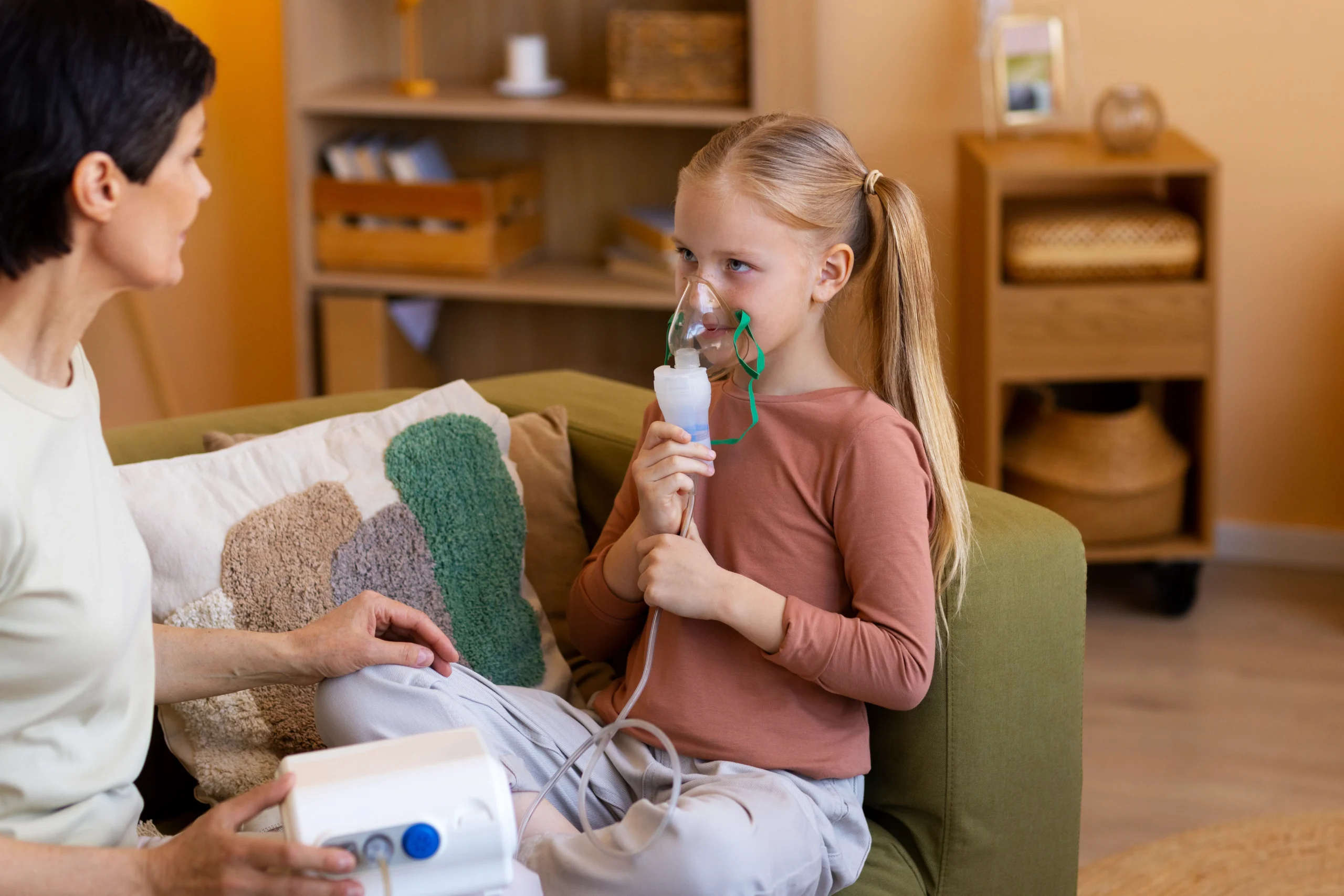
Nebulization therapy at home delivers prescribed respiratory medication through a nebulizer machine, administered by a trained nurse in the patient’s own home instead of a clinic. WeCare24 provides this service across Mangalore, Bangalore, Mysore, Udupi, and Manipal, strictly according to the treating doctor’s prescription.
For patients with asthma, COPD, or other respiratory conditions, regular nebulization treatments can ease breathing and manage symptoms without repeated clinic visits for a short, frequent treatment.
What Home Nebulization Includes
- Prescribed medication administration using properly calibrated nebulizer equipment
- Correct equipment setup and sterile technique for every session
- Monitoring of breathing and oxygen levels during and after treatment
- Guidance on recognising worsening symptoms that need medical attention
- Scheduled repeat visits for patients with ongoing respiratory conditions
- Equipment hygiene guidance to prevent contamination between uses
- Guidance on cleaning and storing the nebulizer equipment safely between sessions
Signs Home Nebulization May Help
- Frequent breathlessness or wheezing that needs regular medicated treatment
- A diagnosed respiratory condition like asthma or COPD requiring scheduled sessions
- Difficulty travelling to a clinic for short, frequent treatments
- Recovery from a respiratory infection with doctor-prescribed nebulization
Why Choose Home-Based Nebulization
Repeated clinic visits for a short nebulization session can be exhausting, particularly for elderly patients, young children, or those with limited mobility. Home-based nebulization removes that burden while maintaining the same clinical standard, correct dosage, proper technique, and careful monitoring throughout each session, exactly as prescribed by the treating doctor.
This is especially useful for elderly patients who find repeated travel difficult, and for children who are often more settled and cooperative receiving treatment in a familiar home environment.
Nebulizer Types Commonly Used
| Type | Typical Use |
|---|---|
| Jet nebulizer | Common, reliable option for most prescribed respiratory medications |
| Ultrasonic nebulizer | Quieter operation, often used for certain medication types |
| Mesh nebulizer | Compact and portable, suited to frequent or travel-friendly use |
Who Benefits from This Service
- Patients with asthma requiring regular bronchodilator therapy
- Patients with COPD or other chronic respiratory conditions
- Patients recovering from a respiratory infection
- Elderly patients with reduced mobility who find clinic visits difficult
What Affects the Nebulization Care Plan
The right plan depends on the treating doctor’s prescription and the patient’s condition:
- The frequency and duration of prescribed sessions
- Whether it’s a single visit or an ongoing course
- Any additional monitoring needs during treatment
We recommend a short consultation so we can confirm the right schedule with you. You can book a consultation or check our FAQs page for more on how our care plans are put together.
How It Works
- Prescription review: we check the patient’s prescription and current respiratory condition
- Scheduling: a single session, a short course during a flare-up, or an ongoing schedule for chronic condition management
- Blood pressure and pulse check: our nurse checks blood pressure and pulse before and after each session
- Documentation: the patient’s response is recorded and shared with the family
How a Nebulizer Works
A nebulizer turns liquid medicine into a fine mist. The patient breathes this mist in through a mask or a mouthpiece, so the medicine reaches the airways and lungs directly. Because the drug acts exactly where it is needed, many patients feel relief within minutes.
The machine has three main parts. A compressor or mesh unit creates the mist, a medicine cup holds the liquid, and a mask or mouthpiece delivers it to the patient. In jet models, tubing connects the compressor to the cup. Our nurses check each part before every session, because a loose connection or a worn mask can reduce how much medicine the patient actually receives.
Nebulization also works well for people who cannot use an inhaler properly. Young children, frail elderly patients, and people who are very breathless often cannot time a puff with a deep breath. A nebulizer needs only normal, relaxed breathing, which makes treatment far easier for them.
Medicines Commonly Given by Nebulizer
We give only what the treating doctor has prescribed. The following groups are the ones most often prescribed for home nebulization:
- Bronchodilators, such as salbutamol, levosalbutamol, or ipratropium, which relax the airway muscles and ease wheezing.
- Inhaled steroids, such as budesonide, which reduce swelling and inflammation in the airways.
- Combination solutions, such as salbutamol with ipratropium, which a doctor may choose during a flare-up.
- Saline solutions, which loosen thick mucus so the patient can cough it out more easily.
The doctor decides the drug, the dose, and the number of sessions. Our nurses do not change a prescription, mix medicines on their own, or suggest a substitute. If the patient’s breathing changes or the medicine seems less effective, the nurse informs the family and the doctor at once.
What Happens During a Home Nebulization Visit
Every visit follows the same careful routine, so the family always knows what to expect:
- Prescription check: the nurse reads the prescription, confirms the patient’s name, the drug, and the dose, and asks about any allergies.
- Baseline reading: the nurse notes the patient’s breathing rate, pulse, and oxygen saturation before treatment starts.
- Equipment setup: the nurse washes hands, assembles a clean nebulizer set, and measures the medicine into the cup.
- Positioning: the patient sits upright, supported by pillows if needed, because this position lets the lungs expand fully.
- Treatment: the patient breathes slowly and evenly through the mask or mouthpiece until the cup is empty, which usually takes 10 to 15 minutes.
- Observation: the nurse watches for coughing, tremor, a racing heartbeat, or increased breathlessness throughout the session.
- Repeat reading: pulse, breathing rate, and oxygen saturation are checked again after the treatment.
- Cleaning and record: the nurse cleans the equipment, notes the patient’s response, and shares a short update with the family.
Nebulizer or Inhaler: Understanding the Difference
Many families ask whether an inhaler can replace a nebulizer. The answer depends on the patient’s condition and the doctor’s advice. The table below shows how the two compare in everyday use.
| Feature | Nebulizer | Inhaler with spacer |
|---|---|---|
| Breathing effort | Normal, relaxed breathing is enough. | Needs a slow, deep breath timed with each puff. |
| Best suited to | Young children, frail elderly patients, and people during a flare-up. | Stable patients who can follow the technique. |
| Time per dose | About 10 to 15 minutes. | A few minutes. |
| Portability | Needs a power source or a battery. | Small and easy to carry. |
| Who decides | The treating doctor. | The treating doctor. |
However, never swap one for the other without asking the doctor. Each device delivers medicine differently, so the dose and the technique are not interchangeable.
Caring for Nebulizer Equipment at Home
Dirty equipment can carry germs deep into the lungs, so cleaning matters as much as the medicine itself. Our nurses teach families the following routine:
- Wash the medicine cup, mask, or mouthpiece in warm soapy water after every session.
- Rinse well and shake off the excess water.
- Air dry the parts on a clean tissue or towel before storing them, because damp parts encourage germ growth.
- Disinfect the parts as the manufacturer advises, often once a week.
- Do not put the compressor in water. Wipe the outside with a clean, damp cloth instead.
- Replace the mask, mouthpiece, and tubing when they look worn, cloudy, or discoloured.
- Check the air filter on the compressor and change it as the instructions say.
Use only medicine that the doctor prescribed, and throw away any leftover medicine after each session. Do not store it in the cup for later use.
Nebulization for Children and Elderly Patients
Children and elderly patients need a slightly different approach, even though the treatment is the same.
For children, a child-sized mask must fit snugly over the nose and mouth. A loose mask lets the mist escape and reduces the dose. Our nurses use calm, simple explanations, and many children sit comfortably on a parent’s lap during the session. Because crying reduces how much medicine reaches the lungs, we wait until the child is settled and breathing evenly. We also suggest wiping the child’s face afterwards, especially when a steroid has been used.
For elderly patients, the focus is on comfort and safety. We support the patient in a chair or propped up in bed, watch for dizziness or a fast heartbeat, and keep the session unhurried. Patients with dementia or hearing difficulty may need extra reassurance, so the nurse speaks slowly and stays with them throughout. Families caring for a parent with a long-term lung condition can read more in our guide to COPD and respiratory care at home.
Possible Side Effects and What Nurses Watch For
Most patients tolerate nebulization well. However, some medicines can cause mild, short-lived effects, and our nurses watch for them during every session:
- A fine tremor in the hands or a feeling of restlessness.
- A faster heartbeat or palpitations.
- A dry mouth, a sore throat, or hoarseness.
- Coughing at the start of the treatment.
- White patches in the mouth after repeated steroid use, which is why we advise rinsing the mouth afterwards.
These effects usually pass within a short time. If they continue, or the patient feels worse, the nurse stops the session and contacts the treating doctor.
Warning Signs That Need Urgent Medical Help
Nebulization is a supportive treatment, not a replacement for emergency care. Call the treating doctor or an ambulance without delay if the patient shows any of the following:
- Severe breathlessness that does not improve after the treatment.
- Blue or grey lips or fingertips.
- Chest pain or a very fast, irregular heartbeat.
- Swelling of the face, lips, or tongue, or a sudden rash.
- Confusion, extreme drowsiness, or difficulty speaking.
- Wheezing that becomes louder or more frequent after the session.
Patients who need oxygen alongside nebulization can read about our oxygen therapy at home service. Patients with a breathing tube can find details on tracheostomy care at home.
Tips for a More Effective Session
- Sit upright and relax the shoulders before starting.
- Breathe slowly and evenly through the mouth, with a small pause at the end of each breath.
- Hold the mask firmly so no mist escapes around the eyes.
- Avoid talking during the session, because talking interrupts the breathing pattern.
- Tap the cup gently near the end so the last drops of medicine are used.
- Wash the face and rinse the mouth after treatment, especially after a steroid.
- Keep a simple diary of the times, symptoms, and any changes so the doctor can review it.
How Often Is Nebulization Needed?
No single schedule suits every patient. During an acute flare-up, a doctor may prescribe sessions several times a day for a few days. For stable chronic conditions, treatment may be once or twice daily, or only when symptoms appear. Some patients also need a short course after a chest infection.
Our visits follow the prescription exactly. When a patient needs regular sessions, we set a fixed time slot so that treatment stays consistent, and we update the family on any change in the patient’s response. If the doctor changes the plan, we adjust the schedule at once.
Nebulization Therapy Across Our Service Areas
WeCare24 provides nebulization therapy at home in Mangalore, Bangalore, Mysore, Udupi, and Manipal. Families in Mangalore can also explore our home nursing services in Mangalore, and families in Bangalore can see our home nursing services in Bangalore. Older patients who need long-term help at home may also benefit from our elder care services in Mangalore.
To arrange a visit, you can book a consultation. Please keep the doctor’s prescription ready, because the nurse needs to see it before the first session. Our FAQs page answers common questions about timing, charges, and how we match nurses to patients.
Frequently Asked Questions
Do I need a prescription for nebulization at home?
Yes. All nebulization treatments are administered strictly according to a valid prescription from your treating doctor. We do not administer medication without proper medical authorisation.
How long does a nebulization session take?
Most sessions take around 10 to 15 minutes, though this can vary depending on the medication and the patient’s condition.
Can this be arranged as a single visit?
Yes. We accommodate single visits for occasional need as well as scheduled recurring visits for patients managing a chronic respiratory condition.
Is nebulization safe for elderly patients?
Yes, when administered by trained staff following the doctor’s prescription and monitoring the patient’s response throughout. Our nurses are attentive to the specific needs of elderly patients during treatment.
Can children receive nebulization therapy at home?
Yes, with a valid prescription from the child’s doctor. Our nurses adapt their approach to keep the child comfortable and cooperative during the session.
Do you provide this service in Udupi and Manipal too?
Yes. Nebulization therapy at home is available across Mangalore, Bangalore, Mysore, Udupi, and Manipal.
