
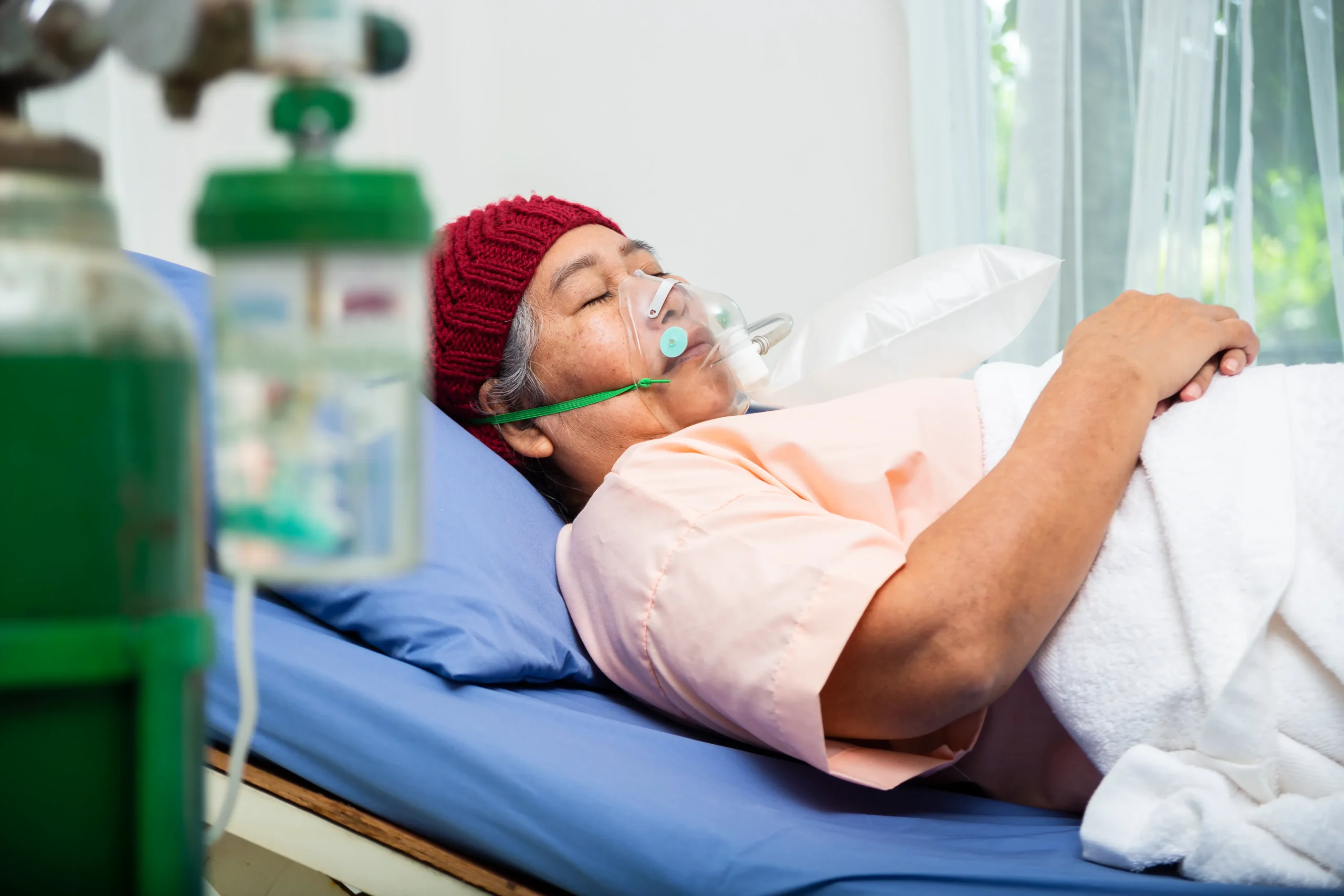
Ventilator care at home is mechanical respiratory support provided outside the hospital, managed by ICU-experienced nurses under the direct instructions of the patient’s treating doctor. It is only appropriate once a patient is medically stable enough for home-based care, as confirmed by the discharging hospital team. WeCare24 provides this service across Mangalore, Bangalore, Mysore, Udupi, and Manipal.
Some patients recovering from critical illness, major surgery, or living with chronic respiratory conditions continue to need mechanical ventilation support even after leaving the ICU. A home setting can allow this to continue safely, without an extended hospital stay, once the treating team confirms it is appropriate.
What Home Ventilator Care Involves
- Continuous monitoring of ventilator settings, oxygen saturation, and breathing patterns by ICU-experienced nursing staff
- Airway suctioning and management to keep the airway clear and prevent complications
- Health tracking with prompt response to any sign of respiratory distress
- Coordination with the treating pulmonologist or intensivist for any changes to ventilator settings
- Equipment checks covering the ventilator, backup power supply, and oxygen source to make sure uninterrupted support
- Emergency response protocols in case of equipment malfunction or sudden patient distress
- Detailed shift-to-shift handover notes so every nurse is fully briefed on the patient’s current status
Signs a Patient May Be Ready for Home Ventilator Care
- The treating doctor has confirmed the patient is medically stable on their current ventilator settings
- The patient no longer needs other acute ICU-level interventions
- The family has a suitable home setup for equipment and a assigned space for nursing care
- A reliable backup power and emergency plan can be arranged
Why Families Choose Home-Based Ventilator Support
Being on a ventilator no longer has to mean an extended hospital stay. For patients who are medically stable but still require respiratory support, a home setting offers assigned one-on-one nursing attention that a busy hospital ward often cannot provide, along with the comfort of familiar surroundings and closer family involvement.
Home ventilator care is always set up in direct coordination with the discharging hospital and treating doctor, who determine the patient’s suitability for home care and the exact settings to be maintained. Our nurses do not alter ventilator settings independently, every parameter follows the treating physician’s orders, and any change in the patient’s condition is escalated to the doctor promptly.
ICU vs Step-Down vs Home Ventilator Care
| Setting | Typical Patient | Level of Supervision |
|---|---|---|
| ICU | Acutely unstable, needs constant multi-specialist monitoring | 24/7 ICU team, on-site doctors |
| Step-down unit | Improving but not yet stable enough for home | Reduced nurse-to-patient ratio, still hospital-based |
| Home ventilator care | Medically stable, doctor has approved home care | Assigned nurse(s), doctor-coordinated care plan |
Who This Service Is Suitable For
- Patients being weaned off hospital ventilation who remain stable but still need support
- Patients with chronic respiratory conditions requiring long-term ventilation
- Post-surgical patients recovering from procedures affecting breathing function
- Neurological patients with compromised respiratory function
What Affects the Home Ventilator Care Plan
Every home ventilator setup is different, and the right plan depends on a few factors:
- Whether round-the-clock or shift-based nursing coverage is needed
- The complexity of the patient’s respiratory condition
- Equipment requirements, including backup power and monitoring devices
- Any additional critical-care needs alongside ventilator support
Because this is a higher-acuity service, we recommend a detailed consultation before finalising a plan. You can book a consultation or check our FAQs page for more on how our care plans are put together.
How We Set Up Home Ventilator Care
- Hospital coordination: we work with the discharging team and treating doctor to understand exact settings and needs
- Staffing plan: we assign nursing staff with relevant critical-care experience and arrange coverage
- Equipment setup: ventilator, backup power, oxygen supply, and monitoring devices are confirmed before care begins
- Ongoing coordination: regular updates to the treating doctor as the patient’s condition is monitored
Types of Home Ventilators and Breathing Support
A ventilator is a machine that helps a patient breathe by moving air into the lungs. At home, support usually comes in two forms. Non-invasive ventilation delivers air through a tight-fitting mask over the nose or face. Invasive ventilation delivers air through a tube placed in the windpipe, usually through a small opening in the neck called a tracheostomy.
The treating pulmonologist chooses the type, the mode, and every setting. Our nurses never change these settings on their own. Their job is to run the machine exactly as prescribed, watch the patient closely, and report anything unusual to the doctor.
Equipment Needed at Home
A safe home set-up needs more than the ventilator itself. Before the patient is discharged, we help families check that the following items are ready and working:
- The main ventilator, plus a spare or backup unit if the doctor advises it.
- A backup power source, such as a battery pack or an inverter, in case of a power cut.
- An oxygen supply, either a concentrator or cylinders, when the doctor has prescribed oxygen.
- A suction machine to clear secretions from the airway.
- A humidifier and spare breathing circuits.
- A manual resuscitation bag for emergencies.
- A pulse oximeter to check oxygen levels in the blood.
- Clean gloves, dressings, and tube ties for daily care.
It also helps to place the machine on a stable table near the bed, close to a working power socket. Keep the area clean, dry, and free from dust and mosquitoes.
Preparing the Room and the Family
The room matters as much as the machine. A clean, well-lit room with good airflow lowers the risk of chest infections. We suggest keeping the bed at a comfortable height, with enough space on both sides for a nurse to work. Extension wires should be tidy, and the ventilator plug should be clearly marked so nobody switches it off by mistake.
Family members should also know where the emergency contact numbers are kept. A printed card near the bed, with the doctor, the nurse, the nearest hospital, and the ambulance number, saves precious time during a crisis.
A Typical Daily Nursing Routine
Home ventilator care follows a steady rhythm. Although each patient is different, a typical day includes these steps:
- Morning check: confirm the machine is running on the prescribed settings, the alarms are on, and the power source is connected.
- Patient assessment: note breathing effort, colour, alertness, pulse, and oxygen level.
- Airway care: clear secretions with suction when needed and clean the area around the tube or mask.
- Circuit and humidifier check: look for water in the tubing, loose joints, or leaks.
- Comfort and positioning: change the patient’s position and check the skin for redness.
- Feeding and medicines: give them as prescribed by the doctor.
- Recording: write down observations so the next nurse and the doctor can see the full picture.
Circuit, Humidifier, and Infection Prevention
The breathing circuit is a direct path to the lungs, so it must stay clean. Our nurses wash their hands before every contact and wear gloves when handling the circuit. Water that collects in the tubing is drained away from the patient, never back toward the airway.
Circuits, filters, and humidifier chambers are changed or cleaned at the intervals the doctor and equipment supplier recommend. Distilled or sterile water is used in the humidifier, because tap water can carry germs. Families should never reuse single-use parts, even if they look clean.
Understanding Ventilator Alarms
Alarms are a safety feature, not a nuisance. They tell the caregiver that something needs attention, and they should never be silenced and ignored. Common reasons for an alarm include the following:
- A loose or disconnected tube or mask.
- Water or secretions blocking the circuit.
- A leak around the mask or tracheostomy.
- A patient who coughs, moves, or is struggling to breathe.
- A low battery or a power failure.
The first step is always to look at the patient, not the machine. If the patient looks unwell, blue, or distressed, call for emergency help and use the manual resuscitation bag while waiting. Our nurses train families to follow this order calmly.
Power Cuts and Emergency Planning
Power failure is the most common worry for families in Mangalore and Bangalore. A written emergency plan removes much of that fear. It should list who to call, where the backup battery is, how long it lasts, and which hospital will receive the patient if needed.
We suggest testing the backup power on a regular schedule, charging all batteries, and keeping a second power option ready, such as a fully charged inverter. If you live in an area with long outages, talk to us before discharge so the plan can be built around your situation.
Airway Care and the Tracheostomy Link
Many long-term ventilator patients also have a tracheostomy tube. Keeping that tube clean, secure, and open is part of ventilator care. Our nurses clean the site, change dressings, and watch for signs of infection or blockage. Families who want a deeper understanding can read our guide to tracheostomy care at home.
Oxygen and Nebulizer Support
Some patients need extra oxygen through the ventilator, and others need inhaled medicines to loosen secretions. These should always follow the doctor’s prescription. You can learn more about oxygen therapy at home and nebulization therapy at home, both of which often form part of the same care plan.
Communication and Emotional Comfort
Being connected to a machine can feel frightening, especially for a patient who cannot speak. Our nurses speak slowly, explain what they are doing, and make eye contact. Simple tools, such as a picture board, a writing pad, or a yes and no signal, help the patient express pain, thirst, or worry.
Families play a big part too. Familiar voices, prayers, music, and visits from relatives often bring comfort. A calm room helps the patient rest and breathe more easily.
Nutrition and Swallowing
Patients on a ventilator often struggle to chew and swallow safely. Some are fed through a tube placed in the nose or the stomach, and the doctor or dietitian decides the right plan. Our nurses keep the head raised during and after feeds, check the tube position, and watch for coughing or vomiting. You can read more about tube feeding care at home.
Skin, Position, and Pressure Care
A patient who spends most of the day in bed is at risk of pressure sores. The ventilator tubing, mask straps, and tracheostomy ties can also press on the skin. Our nurses change position at regular intervals, use pressure-relieving mattresses where advised, and check the skin daily. For wider guidance, see our page on bedridden patient care.
Follow-Up, Weaning, and Doctor Reviews
Some patients improve enough to use the ventilator for fewer hours each day. This process, called weaning, is planned and monitored by the doctor. Other patients need long-term support. In both cases, regular reviews with the pulmonologist keep the settings suitable. We share our daily notes with the doctor and arrange follow-up visits when needed.
Questions to Ask Before Discharge
Clear answers from the hospital team make the move home much safer. It helps to ask about the following:
- The exact ventilator type, mode, and settings the patient needs.
- How many hours each day the patient depends on the machine.
- Who supplies and services the equipment, and who to call if it fails.
- The signs that mean the family should call the doctor straight away.
- Which hospital will take the patient in an emergency.
- How often the circuit, filters, and tubes need changing.
Training for Family Caregivers
Even with a trained nurse present, family members should learn the basics. We teach them how to recognise distress, silence an alarm safely, use the manual bag, and call for help. This training gives families confidence and means the patient is never left without a capable person nearby.
Combined Care and Service Areas
Ventilator care is often one part of a larger plan. Patients with long-term lung disease may also benefit from COPD care at home, and those with limited movement can explore paralysis care at home.
WeCare24 provides ventilator care in Mangalore, Bangalore, Mysore, Udupi, and Manipal. You can browse our home nursing services in Mangalore or home nursing services in Bangalore, or book a consultation to plan the right nursing schedule.
Frequently Asked Questions
Is it safe to manage a ventilator-dependent patient at home?
Yes, when the patient is medically stable and care is delivered by trained nursing staff following the treating doctor’s exact instructions, with proper equipment and backup systems in place. Suitability is always assessed by the discharging medical team first.
What kind of staff manage home ventilator patients?
We assign nursing staff with relevant critical-care or ICU experience, trained in airway management, ventilator monitoring, and emergency response.
What happens during a power outage or equipment failure?
Every home ventilator setup includes a backup power plan, and our nurses are trained to respond immediately to equipment issues while coordinating with the treating doctor and, where necessary, emergency services.
Can a patient move from ICU directly to home ventilator care?
Only once the discharging doctor confirms the patient is stable enough for home-based ventilation. We coordinate closely with the hospital’s discharge planning team to make sure a safe transition.
Do you coordinate directly with the hospital before discharge?
Yes. We work with the discharging hospital’s team to understand the patient’s exact settings, equipment needs, and monitoring requirements before care begins at home.
Is ventilator care available outside Mangalore?
Yes. We provide home ventilator care across Mangalore, Bangalore, Mysore, Udupi, and Manipal.
